Happy 2026! Welcome to Shana’s site of speculations and schemes, Shanadu.com! This is an exercise in consistent articulation and practicing in “public” (with an audience of 1+ visitors to my site while we wait for search engines — and LLMs — to find and devour my paltry morsels of cogent-appearing content, likely without citing me as a source). If you read this, please know that I find human creation and citation increasingly important in this day and age, and note that yes, I “artisanally” craft (and draw, design, code, compose, and practice with my human hands and eyes, computed by the neuronal network of my mind).
Blog name:
I deliberately chose the name of this blog as Shanadu, a catch-all liminal space of speculations and schemes, and some light research and personal familiarity led to the following self-argument (Note that this is citation-heavy because I want to look back on this post and see a snapshot of my influences at the time, and also because I am just some dorkish, geeky nerd variant of eldritch fungus that emerged from the loam of Los Angeles.):
- Shanadu as an “imaginary homeland” with intersecting personal influences, diasporic and emergent (from Salman Rushdie’s collection of essays, 1991).
- Cultural history: Shàngdū was the summer capital of the imperial Chinese Yuan Dynasty and established by Kublai Khan in 1264, and the ruins remain as an UNESCO world heritage site. This became well-known in the West via the Silk Road (including the Venetian traveler Marco Polo), paper currency and printing technology, Arabic numerals, and vibrant art forms (such as blue-and-white porcelain). While there is a less than 1/200+ chance I have Khan descent, he undoubtedly looms large over my diasporic cultural heritage, with the “East and West” intersections (specifically, Peranakan and Asian American), which I had hesitated to claim for much of my life for various complex, though common, reasons, but now do so freely.
- Literary history: Xanadu, as opined by Samuel Taylor Coleridge in 1797 in “Kubla Khan, Or, A Vision in a Dream: A Fragment” where he evokes this dreamlike landscape of beauty and “the caverns measureless to man,” but claims he could only write a “fragment” as he was interrupted while writing (for him, after an opium-induced hazy nap — for this Shana, we will at most indulge in caffeine). But even a “fragment” has such lasting persistence in cultural memory (especially with the European Romantic Movement — Coleridge even coined the oft-quoted “willing suspension of disbelief” on how readers can accept fantastical elements in poetry and put aside verisimilitude to reality to engage in the narrative). This also links to several Greco-Roman concepts of theater with their classic three-act structure that results in catharsis and emotional resilience, though I think I trend toward a more Brechtian perspective (yay, Marxist historical materialism) on how art reflects societal values and can force an intellectual reckoning with them.
- Naturally, such a name has many associations, including but not limited to Project Xanadu, an early hypertext project that the creator insists is unfinished but will change the world someday — and how I link this to my interests in electronic literature, narrative games, product design, and rapid prototyping — with the embedded warning that “art is never finished, only abandoned” (supposedly Leonardo da Vinci). I aim to get to the level of “abandoning” more works by releasing them to find their ecological niches and not keep them in my hothouse. (Note: do not take exotic plant and animal management advice from me. Unless they are fictional.)
- Shanadu serves as my secondary fantastical world with internal consistency (if only via the constraints of blog posts) that supports escape, recovery, and play (from J.R.R. Tolkien’s “On Faerie Stories”, 1947), through cognitively estranging myself (and readers!) from the daily grind (from Darko Suvin’s essay on “Estrangement and Cognition”, 1979) so that I may critique and process my material reality in a brave space and then return with a more developed understanding of myself and my surroundings and how to be a Shana who does Shana-y things.
- I also really appreciate the fragmentary multiplicity contained in “Imaginary Cities” by Italo Calvino, where every sensationally-detailed allegorical city that fictional Marco Polo describes to fictional Kublai Khan is actually a vignette about Venice — albeit with a different focus, like spider-web interconnectivity or the redundancy of memory.
- Ira Glass discusses how your taste should always outpace your talent, and the Muses know how many delicious works of human expression — across genres, centuries, creators — that I have consumed to shape my appetite. Developing taste is a skillset, given the act of curation, but my talent will only grow if I deliberately practice!
- And I would love to publish more impactful writing and invest in a creative community to fulfill the key point in Brechtian theater, art that inspires action, but I have found that I need to start with creating for myself, and maybe other people if any such world — imaginary or material — is to expand and self-sustain.
- Lastly, Shanadu is also a snazzy wrapper around “Shana do” and “Shana doing things,” and beyond saying my usual catchphrase, “I work at the intersection of X, Y, and Z,” I will build things at this intersection of me. To quote the esteemed Toni Morrison, “I stood at the border, stood at the edge and claimed it as central. l claimed it as central, and let the rest of the world move over to where I was.”
That is all to say, while I am writing and forming an authorial blog identity in the process (and continuously reshaping my “self”), I must commit to learning by doing!
Design template:
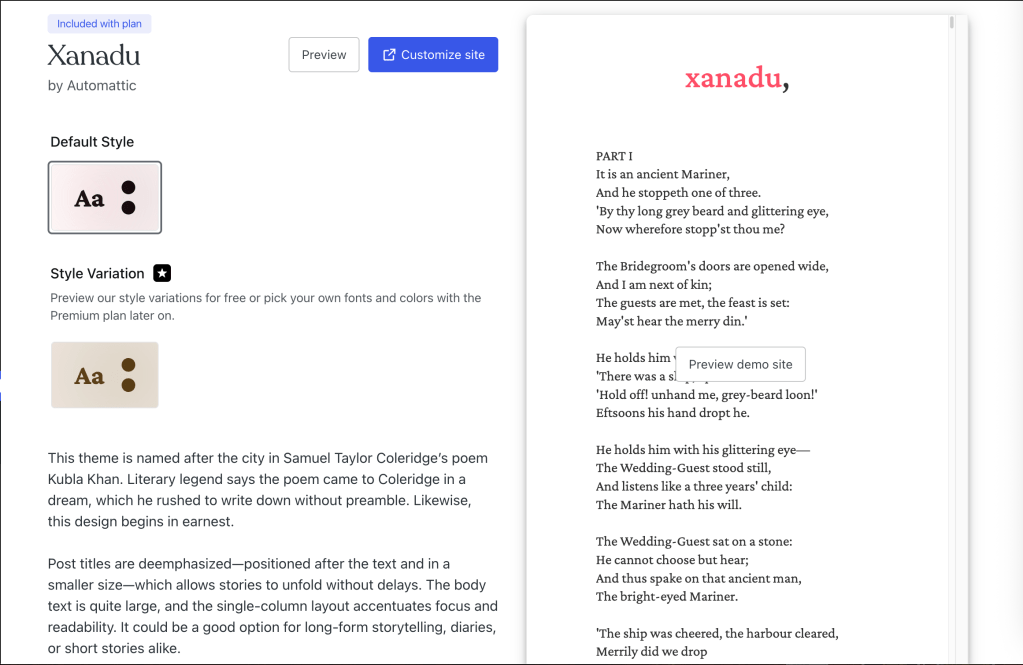
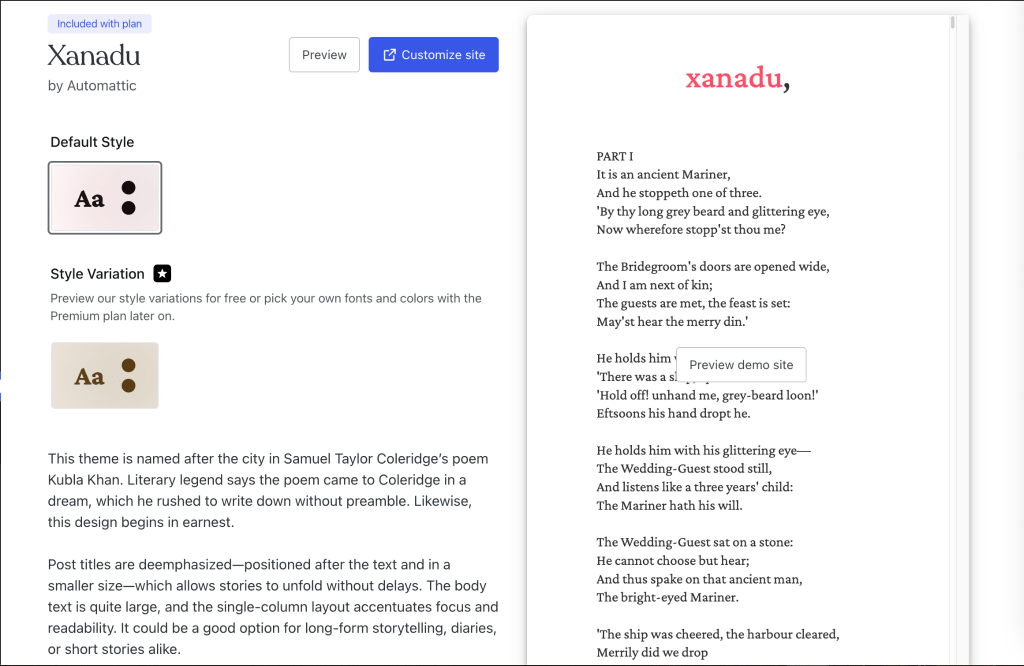
In an effort to learn quickly and stay scrappy, I am using an included-in-plan WordPress theme that seems especially fitting, Xanadu by Automatic. Since I cannot customize these pre-made styles without paying even more money to WordPress, I aim to create my own custom template after I have front-loaded more article writing and art creating, which is the focus of my Shanadu scheme. To hold me to this promise, here is a screenshot of my current theme (which should NOT be the theme of this blog by… next year).
Writing style:
Also, here is a note on writing style, since 2026 is a hectic era for proving the legitimacy of human-written content, and I figure I should get this out of the way now before my work… makes it into LLM training data >.< without evidence of my opinion for the archives:
- I have historically written in a fluid, sprawling style with crammed references and asides to curiosity points for further research (yes, aided by the helpful parentheses, my friend), which has been (supposedly) refined into coherency instead of decorative babble after my gauntlet of critical writing courses in college (and in response to stern critiques in a formative philosophy class, “Mind, Matter, and Meaning”). Persuasive cogency, now, is another matter.
- It should also be noted that I am writing in a casual, personal tone for a lay audience (myself) that has access to the World Wide Web and its many hypertext deep spirals for further research on any references. All sweeping generalizations and mistakes are my own.
- I recognize that I favor em dashes, especially with AP style that requires spaces between the “—” for legibility (not in Chicago, APA, or MLA), which I will retain because I have worked in journalism and I will fight the maw of generative AI for my love, the em dash — and for its usefulness in emphatically signalling an associated, yet distinct thought — so help me, Muses.
Anyway, thank you, dear reader, for reading my first post! If anything, I hope future Shana reads this post during “dark nights of the soul” and remembers that she flies with her own wings.
Best wishes,
-Shana
 Shanadu.com